

Introduction
Definition and Key Features
The amniotic egg is a pivotal evolutionary innovation that enabled vertebrates to colonize terrestrial environments independently of water. It is characterized by i) four extraembryonic membranes (amnion, chorion, allantois, yolk sac), ii) a protective shell (calcified in birds/reptiles, leathery in monotremes), and iii) self-contained nutrition and waste storage, eliminating the need for aquatic larval stages.
I. Cleidoic vs. Amniotic Egg
- Cleidoic Egg: A term often used interchangeably with “amniotic egg,” emphasizing its closed system (Greek kleistos = “closed”).
- Amniotic Egg: Specifically refers to eggs with an amnion, a fluid-filled sac protecting the embryo.
- All amniotic eggs are cleidoic, but not all cleidoic eggs are amniotic (e.g., some insect eggs are cleidoic but lack extraembryonic membranes).
II. Structure of the Amniotic Egg
A. The Shell
- Reptiles/Birds: Calcified (rigid in birds, flexible in most reptiles).
- Monotremes: Leathery, resembling reptilian eggs.
- Functions:
- Mechanical protection.
- Permeable to gases (O₂ in, CO₂ out) but limits water loss.
B. The Four Extraembryonic Membranes
1) Amnion
- Structure: Innermost, fluid-filled sac.
- Function:
- Cushions the embryo (shock absorption).
- Prevents desiccation.
2) Chorion
- Structure: Outermost membrane, adjacent to the shell.
- Function:
- Facilitates gas exchange.
- In birds, fuses with the allantois to form the chorioallantoic membrane (respiratory surface).
3) Allantois
- Structure: Sac extending from the embryo’s gut.
- Function:
- Stores nitrogenous waste (uric acid in birds/reptiles).
- Assists in gas exchange (vascularized).
4) Yolk Sac
- Structure: Nutrient-rich pouch attached to the embryo.
- Function:
- Provides lipids, proteins, and vitamins.
- In placental mammals, reduced or vestigial.
C. The Albumen (Egg White)
- Composition: Water (90%), proteins (e.g., ovalbumin).
- Functions:
- Hydration and shock absorption.
- Antimicrobial properties (lysozyme).
III. Functional Significance of Each Component
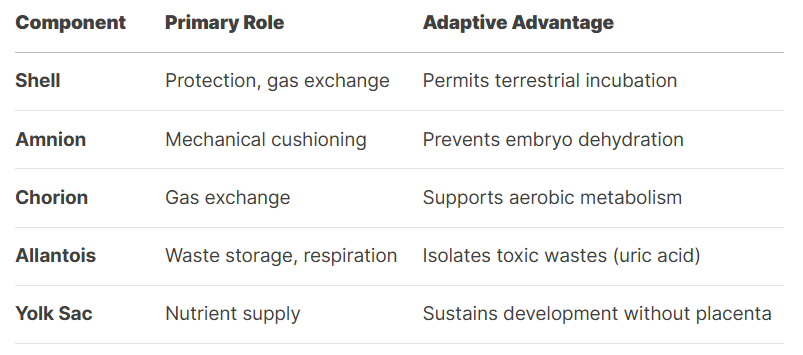
IV. Evolutionary Significance of the Amniotic Egg
A. Transition from Amphibians to Amniotes (~320 MYA)
- Amphibian Constraints: Require water for egg deposition (gelatinous eggs prone to desiccation).
- Amniote Breakthrough: Eggs could be laid on land, enabling independence from aquatic habitats.
B. Key Adaptations for Terrestrial Life
- Water Conservation: Shell and membranes reduce evaporative loss.
- Efficient Respiration: Chorioallantoic membrane optimizes O₂ uptake.
- Waste Management: Uric acid precipitation minimizes water loss.
C. Diversification of Amniotes
- Synapsids: Led to mammals (retained amniotic egg in monotremes; placental mammals internalized it).
- Sauropsids: Diversified into reptiles and birds.
V. Comparative Analysis Across Vertebrates
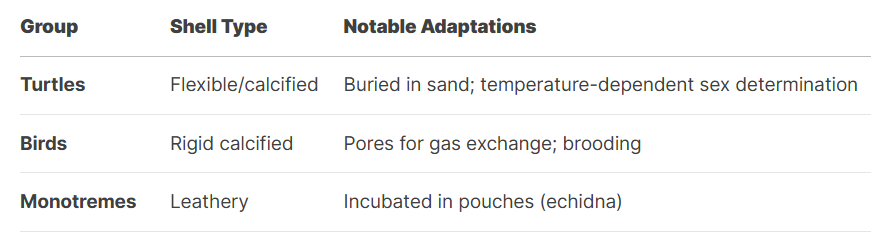
VI. Ecological and Paleontological Insights
A. Fossil Evidence
- Early Amniotes: Hylonomus (Carboniferous) had eggs resembling modern reptiles.
- Dinosaur Eggs: Reveal nesting behaviors (e.g., Maiasaura colonies).
B. Adaptive Radiation
- Arid Climates: Amniotes dominated deserts where amphibians were restricted.
Conclusion
The amniotic egg represents an evolutionary milestone in vertebrate evolution, enabling terrestrial colonization and radiation. Its self-sufficient design (protection, respiration, nutrition) underpins the success of reptiles, birds, and mammals.