

Introduction
Definition and Evolutionary Significance
The vertebrate eye is a complex sensory organ that detects light and converts it into electrochemical impulses, enabling vision. Its evolution represents one of the most remarkable examples of functional convergence, with camera-type eyes appearing independently in vertebrates and cephalopods.
I. General Structure of the Vertebrate Eye
1. Cornea: Transparent outer layer that refracts light.
2. Lens: Focuses light onto the retina.
3. Retina: Contains photoreceptors (rods for low light, cones for colour).
4. Optic Nerve: Transmits visual information to the brain.
5. Accessory Structures: Iris (controls pupil size), sclera (protective outer layer).
II. The Avian Eye: Structure and Adaptations
General Anatomy
- Large eyes relative to skull size (e.g., owls’ eyes occupy 50% of skull volume).
- Pecten oculi: A vascular structure supplying nutrients to the retina (absent in mammals).
- Nictitating membrane: A translucent third eyelid for protection.
Diurnal Birds (e.g., Eagles, Hawks)
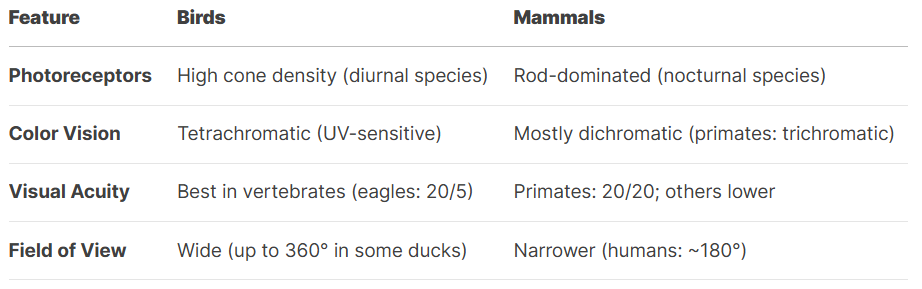
- High cone density for exceptional daytime vision.
- Fovea centralis: A deep pit in the retina for extreme acuity (eagles have 2x human visual resolution).
- Tetrachromatic vision: UV-sensitive cones enhance prey detection.
Nocturnal Birds (e.g., Owls)
- Rod-dominated retinas for superior night vision.
- Tubular eye shape maximizes light capture.
- Asymmetrical ears + binocular vision for precise prey localization.
Aquatic Birds (e.g., Penguins, Cormorants)
- Flat corneas for underwater focus.
- Red oil droplets in cones enhance contrast in dim waters.
III. The Mammalian Eye: Structure and Adaptations
General Anatomy
- Less variation in eye shape compared to birds.
- Tapetum lucidum in nocturnal species (reflects light for enhanced night vision).
Primates (High-Acuity Vision)
- Trichromatic vision (red, green, blue cones) in Old World monkeys and apes.
- Fovea specialization for detailed object recognition.
Nocturnal Mammals (e.g., Cats, Bats)
- Tapetum lucidum causes eyeshine.
- High rod-to-cone ratio (cats: 25:1).
Aquatic Mammals (e.g., Dolphins, Seals)
- Spherical lenses for underwater focus.
- Corneal flattening reduces refractive error when surfacing.
Ungulates and Prey Species (e.g., Deer, Horses)
- Horizontal pupils expand panoramic vision (300° field of view).
- Limited colour vision (dichromatic).
IV. Comparative Analysis of Avian and Mammalian Vision
IV. Major Evolutionary Milestones in Vertebrate Eye Development
1. Early Vertebrates (~500 MYA):
- Evolution of camera-type eyes from light-sensitive patches.
2. Mesozoic Birds (~160 MYA):
- Development of foveae and pecten oculi for flight precision.
3. Nocturnal Adaptations (~100 MYA):
- Tapetum lucidum in mammals; rod specialization in owls.
4. Aquatic Adaptations (~50 MYA):
- Spherical lenses in cetaceans and pinnipeds.
Conclusion
The vertebrate eye demonstrates extraordinary adaptive diversity, from the UV-sensitive retinas of birds to the light-amplifying tapeta of nocturnal mammals. Key evolutionary trends include: i) enhanced acuity in predatory birds and primates, ii) spectral sensitivity expansions (UV in birds, IR in some snakes), and iii) ecological specialization (aquatic flattening, nocturnal tubular eyes).