
Introduction
Definition and Basic Functions
The nervous system is a highly specialized network responsible for:
i) Sensory Input (detecting environmental stimuli), ii) Integration (processing information in the brain and spinal cord), and iii) Motor Output (coordinating muscle and gland responses).
I. Divisions of the Nervous System
1. Central Nervous System (CNS):
- Brain and spinal cord.
- Integrates and processes information.
2. Peripheral Nervous System (PNS):
- Cranial and spinal nerves.
- Connects CNS to limbs and organs.
II. Evolutionary Overview of Vertebrate Nervous Systems
Key Transitions
- Early Chordates (e.g., Lancelets): Simple nerve cord, no true brain.
- Jawless Fish (Agnatha): Rudimentary brain regions (hindbrain, midbrain, forebrain).
- Gnathostomes (Jawed Vertebrates): Enhanced sensory and motor regions.
- Tetrapods: Expansion of forebrain (cerebrum) for complex behaviours.
III. Comparative Neuroanatomy Across Vertebrates
A. Brain Structure and Function
1) Fishes
- Forebrain (Telencephalon): Olfactory processing.
- Midbrain (Optic Tectum): Visual reflexes.
- Hindbrain (Medulla Oblongata): Controls swimming.
2) Amphibians
- Larger Optic Lobes: Enhanced vision for hunting.
- Primitive Cerebellum: Coordinates movement on land.
3) Reptiles
- Expanded Cerebrum: Better spatial memory.
Pineal Gland (“Third Eye”): Light detection in some species.
4) Birds
- Hyperdeveloped Optic Lobes: Superior vision.
- Enlarged Cerebellum: Flight coordination.
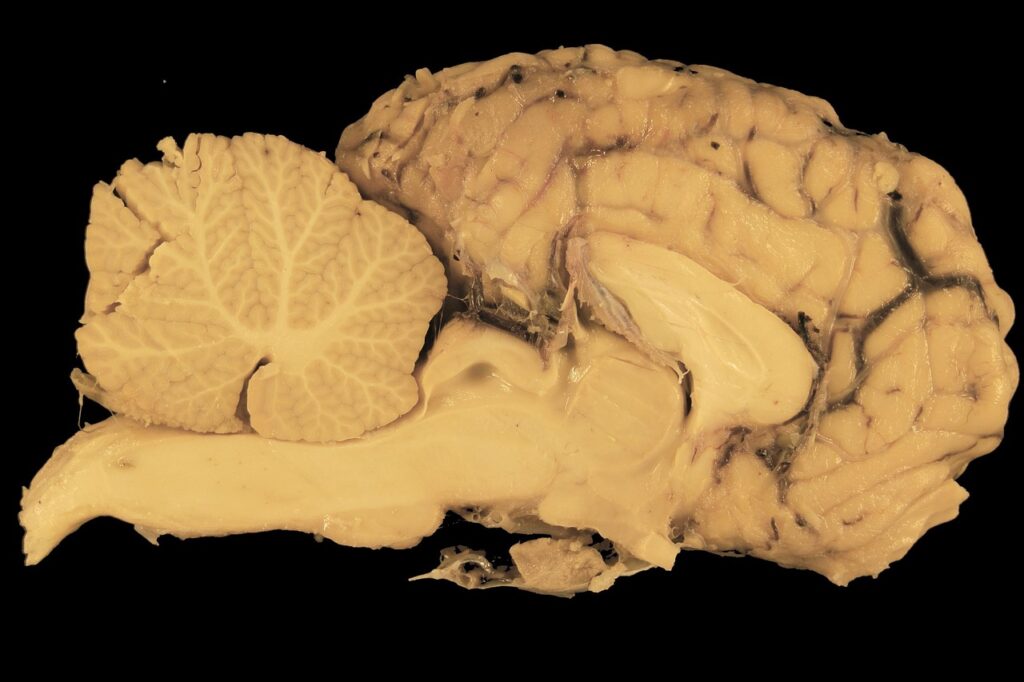
5) Mammals
- Neocortex: Complex cognition, problem-solving.
- Corpus Callosum: Connects brain hemispheres.
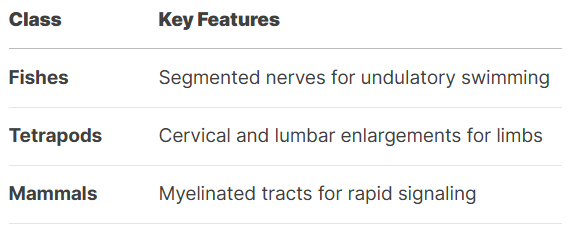
B. Spinal Cord Organization
C. Peripheral Nervous System Adaptations
- Electroreception: Sharks detect electric fields.
- Vomeronasal Organ: Reptiles and mammals detect pheromones.
IV. Major Evolutionary Milestones
A. Development of Myelination (~400 MYA)
- Myelin Sheath: Insulates axons for faster signal transmission.
- First Appeared in: Jawed vertebrates.
B. Encephalization (~320 MYA–Present)
- Brain-to-Body Size Ratio: Increased in mammals and birds.
- Cortical Folding: Maximizes surface area (e.g., human gyri and sulci).
C. Specialized Sensory Systems
- Lateral Line System: Fish detect water vibrations.
- Echolocation: Bats and toothed whales.
V. Functional Adaptations in Different Classes
A. Fishes
- Mauthner Cells: Rapid escape responses.
- Electrosensory Ampullae: Detect prey in murky water.
B. Amphibians
- Binocular Vision: Accurate prey targeting.
- Vibrational Sensing: Detect ground-borne sounds.
C. Reptiles
- Infrared Pit Organs: Snakes sense heat.
- Basal Ganglia: Controls instinctive behaviours.
D. Birds
- Nidopallium Caudolaterale: Avian equivalent of prefrontal cortex.
- Magnetic Sensing: Navigate using Earth’s magnetic field.
E. Mammals
- Prefrontal Cortex: Decision-making, social behaviour.
- Spinothalamic Tract: Pain and temperature perception.
Conclusion
The vertebrate nervous system showcases progressive complexity, from the simple nerve nets of early fish to the highly encephalized brains of mammals. Key innovations include: i) Myelination for rapid signaling, ii) Encephalization for supporting advanced cognition, and iii) Specialized Sensory ability to ecological niches.