
Introduction
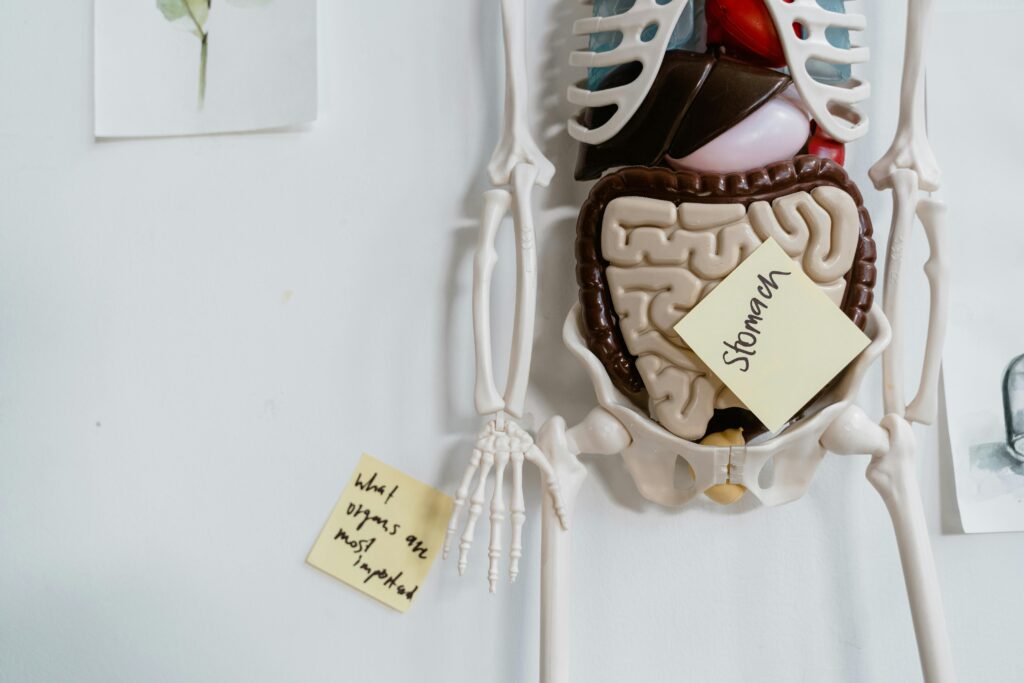
The digestive system is a specialized network of organs responsible for ingestion, digestion, absorption, and elimination of food. It has evolved differently in birds (Aves) and mammals due to their distinct dietary habits, metabolic demands, and ecological adaptations.
Key Functions of the Digestive System:
- Mechanical breakdown of food (chewing, grinding).
- Chemical digestion via enzymes and acids.
- Nutrient absorption in the intestines.
- Waste excretion (feaces formation).
I. Typical Digestive System in Vertebrates
Most vertebrates share a basic digestive tract structure, but specialized adaptations occur based on diet (herbivore, carnivore, omnivore).
Generalized Digestive Tract Components:
- Mouth & Oral Cavity (mechanical digestion).
- Esophagus (food transport to stomach).
- Stomach (acidic breakdown).
- Small Intestine (nutrient absorption).
- Large Intestine (water absorption, feaces formation).
- Accessory Organs (liver, pancreas, gallbladder).
II. Components and Functions of the Digestive System in Birds (Aves)
Birds have a highly specialized digestive system adapted for flight efficiency and diverse diets (granivores, carnivores, nectarivores).
A. Key Structures and Functions:
1) Beak & Oral Cavity
- No teeth (reduces weight for flight).
- Keratinized beak adapted for food type (e.g., hooked in raptors, slender in hummingbirds).
- Salivary glands secrete mucus (limited enzyme action).
2) Esophagus & Crop
- Esophagus: Transports food via peristalsis.
- Crop: A storage pouch in some birds (e.g., pigeons, chickens) that softens food before digestion.
3) Proventriculus (Glandular Stomach)
- Secretes gastric juices (HCl, pepsin) for chemical digestion.
4) Gizzard (Muscular Stomach)
- Thick muscular walls grind food (replaces chewing).
- Birds swallow grit/pebbles to aid mechanical breakdown.
5) Small Intestine
- Duodenum: Receives bile (from liver) and pancreatic enzymes.
- Jejunum & Ileum: Nutrient absorption (villi increase surface area).
6) Ceca (Paired Pouches)
- Ferment plant matter (important in herbivorous birds like chickens).
7) Cloaca
- Common chamber for digestive, urinary, and reproductive tracts.
B. Special Adaptations in Birds:
- Fast digestion (2–12 hrs) due to high metabolic rates.
- Crop milk in pigeons/flamingos for chick feeding.
- Nectar digestion in hummingbirds (rapid sugar absorption).
III. Components and Functions of the Digestive System in Mammals
Mammals exhibit diverse digestive strategies based on diet (ruminants, carnivores, hindgut fermenters).
A. Key Structures and Functions:
1) Mouth & Teeth
- Heterodont dentition (incisors, canines, premolars, molars).
- Salivary enzymes (amylase) begin starch digestion.
2) Esophagus
- Transports food via peristalsis (reverse in ruminants).
3) Stomach
- Monogastric (Simple Stomach):
- Single chamber (e.g., humans, dogs).
- Secretes HCl and pepsin for protein digestion.
- Ruminant Stomach (Four Chambers):
- Rumen, Reticulum, Omasum, Abomasum.
- Ferments cellulose via symbiotic microbes.
4) Small Intestine
- Duodenum: Receives bile and pancreatic enzymes.
- Jejunum & Ileum: Absorb nutrients (longer in herbivores).
5) Large Intestine
- Cecum: Fermentation chamber (large in herbivores like rabbits).
- Colon: Water absorption, faeces formation.
6) Accessory Organs
- Liver: Produces bile (fat emulsification).
- Pancreas: Secretes digestive enzymes (lipase, protease, amylase).
- Gallbladder: Stores bile (absent in some mammals like horses).
B. Special Adaptations in Mammals:
- Ruminants (Cows, Sheep):
- Regurgitate cud for microbial fermentation.
- Carnivores (Cats, Lions):
- Short digestive tract for rapid meat digestion.
- Hindgut Fermenters (Horses, Rabbits):
- Enlarged cecum for cellulose breakdown.
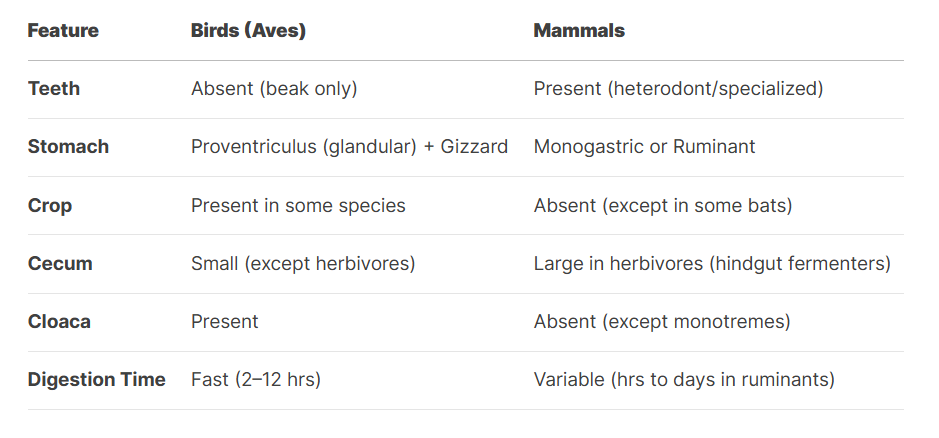
IV. Comparison of the Digestive System in Birds and Mammals
V. Major Evolutionary Functions of the Digestive System in Mammals
1) Early Vertebrates (~500 MYA)
- Agnathans (Jawless Fish): Simple gut, filter-feeding.
- Gnathostomes (Jawed Fish): Stomach evolution for predation.
2) Transition to Land (~375 MYA)
- Amphibians: Short gut for carnivory.
- Reptiles: Longer intestines for herbivory (some dinosaurs).
3) Evolution of Endothermy (~250 MYA)
- Birds & Mammals: High metabolic demand → specialized digestion (gizzard, rumen).
4) Adaptive Radiation in Mammals (~65 MYA–Present)
- Ruminants: Evolved foregut fermentation.
- Carnivores: Short, acidic digestive tracts.
5) Flight Adaptations in Birds
- Lightweight system (no teeth, fast digestion).
Conclusion
The digestive systems of birds and mammals reflect their ecological niches, diets, and metabolic needs. Birds prioritize rapid digestion and lightweight anatomy for flight, while mammals exhibit diverse adaptations (rumination, hindgut fermentation). Evolutionary trends highlight increasing specialization from early vertebrates to modern endotherms.
Introduction
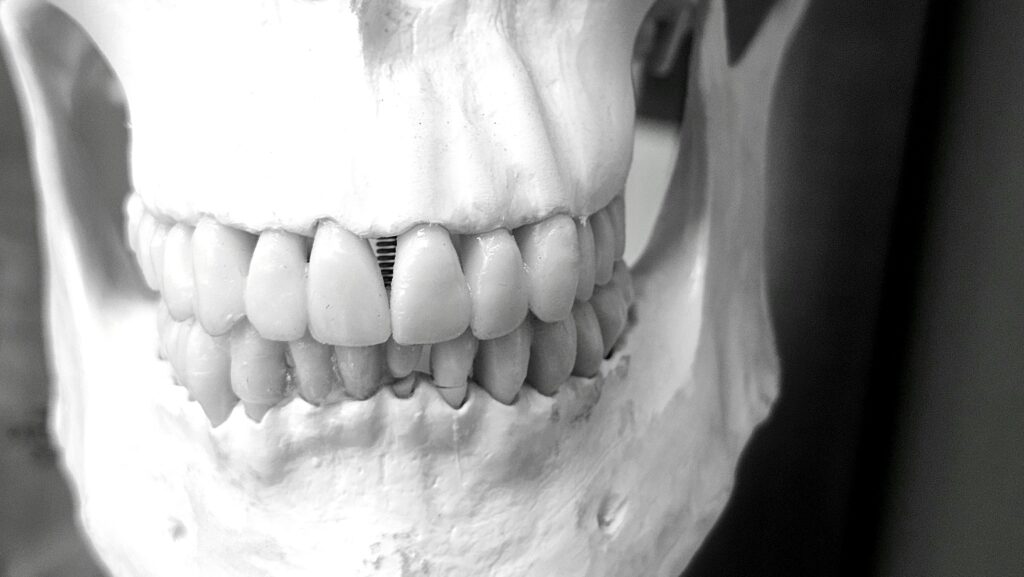
Teeth are mineralized, calcified structures embedded in the jaws of vertebrates, primarily used for mechanical processing of food (mastication), defense, and in some species, social interactions.
Functions of Teeth:
- Mastication: Breakdown of food into smaller particles for digestion.
- Prehension: Grasping and holding prey (e.g., carnivores).
- Defense: Weaponry in predators (e.g., canines in big cats).
- Social Signaling: Display structures (e.g., tusks in elephants).
Evolutionary Significance:
- Teeth are one of the most well-preserved fossil structures, providing key insights into vertebrate evolution.
- Mammals exhibit the highest degree of dental specialization among vertebrates.
I. Structure and Types of Teeth
A. Tooth Anatomy
A tooth consists of three primary layers:
1. Enamel – Highly mineralized outer layer (hardest substance in the body).
2. Dentin – Softer than enamel, forms the bulk of the tooth.
3. Pulp Cavity – Contains nerves and blood vessels.
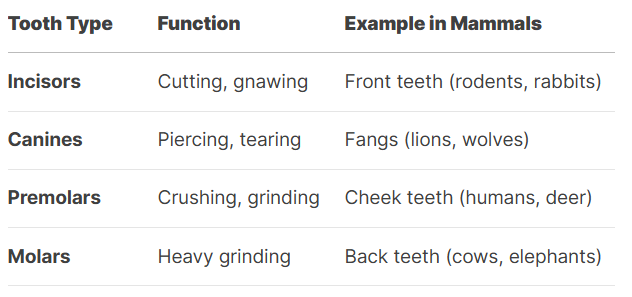
B. Types of Teeth
Mammals exhibit heterodont dentition (differentiated teeth), unlike reptiles and fish, which typically have homodont dentition (uniform teeth).
II. Dentition in Mammals
A. Dental Formula
A standardized notation representing the number of each tooth type in one half of the upper and lower jaws.
Example Dental Formulas:
- Human: 2.1.2.3 / 2.1.2.3 (I2-C1-P2-M3)
- Dog: 3.1.4.2 / 3.1.4.3
- Cow (Ruminant): 0.0.3.3 / 3.1.3.3
B. Tooth Morphology and Adaptations
1) Carnivorous Mammals
- Sharp, pointed canines for killing prey.
- Carnassial pair (P4/M1) – Modified premolars/molars for shearing flesh.
- Reduced molars (less grinding needed).
- Examples: Lions, wolves, cats.
2) Herbivorous Mammals
- Broad, flat molars for grinding cellulose.
Diastema (gap) between incisors and premolars to accommodate tongue movement.
Hypsodont teeth (high-crowned) in grazers (e.g., horses). - Examples: Cows, deer, elephants.
3) Omnivorous Mammals
- Generalized dentition (mix of sharp and flat teeth).
- Variable molars for both plant and animal matter.
- Examples: Humans, bears, pigs.
4) Specialized Dentition
- Rodents: Ever-growing incisors for gnawing.
- Elephants: Modified incisors (tusks) for digging and display.
- Dolphins/Whales: Homodont teeth for grasping fish.
III. Major Evolutionary Milestones of Dentition in Vertebrates
1) Early Vertebrates (~500 MYA)
- Agnathans (Jawless Fish): No true teeth, but keratinized oral plates.
- Gnathostomes (Jawed Fish): First true teeth (conodonts).
2) Evolution of Heterodonty (~320 MYA)
- Early Synapsids (Mammal-like Reptiles): Differentiation of tooth types.
- Therapsids: Precursors to mammalian canines and molars.
3) Mammalian Dental Specialization (~200 MYA–Present)
- Tribosphenic Molars: Three-cusped molars in early mammals.
- Diphyodonty: Two sets of teeth (deciduous and permanent).
- Hypsodonty: High-crowned teeth in grazers (Miocene epoch).
4) Adaptive Radiation in Cenozoic Mammals
- Carnivorans: Evolution of carnassials.
- Ungulates: Development of complex grinding surfaces (lophodont, selenodont).
IV. Comparative Dentition Across Vertebrate Classes
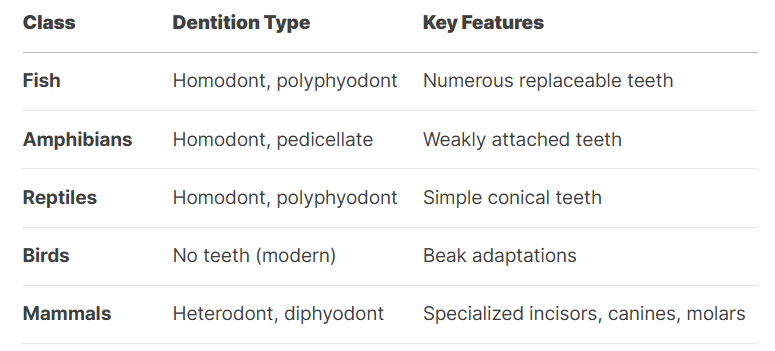
Conclusion
Mammalian dentition represents one of vertebrates’ most specialized and evolutionarily significant adaptations. From the simple conical teeth of early fish to the complex molars of ungulates, teeth provide critical insights into diet, behaviour, and evolutionary history.